How to Estimate a VAR for a Small Open Economy
Guide 1 of 3 in the series VARs for a Small Open Economy
Based on Bayesian Macroeconometrics (Chan, 2027)
[ Full guide on GitHub ]
Developments abroad can have large effects on a small open economy, while domestic developments have little effect abroad. Cushman and Zha (1997) build this asymmetry into a VAR for Canada. The Canadian variables do not enter the equations for the US and world variables, either in the current period or with a lag. This restriction is called block exogeneity.
We build a VAR for a small open economy using eight quarterly US and Australian series from 1984Q1 to 2019Q4. Both the domestic and foreign blocks include real GDP growth and CPI inflation. The foreign (US) block adds the federal funds rate and the excess bond premium. The domestic (Australian) block adds the 3-month interbank rate and the depreciation of the Australian dollar against the US dollar. We follow Zha (1999) and estimate the two blocks separately. Specifically, we first estimate a VAR for the foreign variables. Then we estimate a VAR for the domestic variables, with the current and lagged foreign variables as exogenous regressors.
We fit the VAR with block exogeneity to these data and use the fitted VAR as the true model. We simulate a sample from it and draw from the posterior of each block. We then compare the estimates with those from an unrestricted VAR. In this sample, imposing block exogeneity lowers the mean absolute error from 0.180 to 0.160, over the US coefficients that both VARs estimate.
The steps
- Write the VAR as Two Blocks
- Set the Prior of Each Block
- Choose the Lag Length and the Shrinkage, and Fit the True Model
- Draw from the Posterior of Each Block
- Compare with an Unrestricted VAR
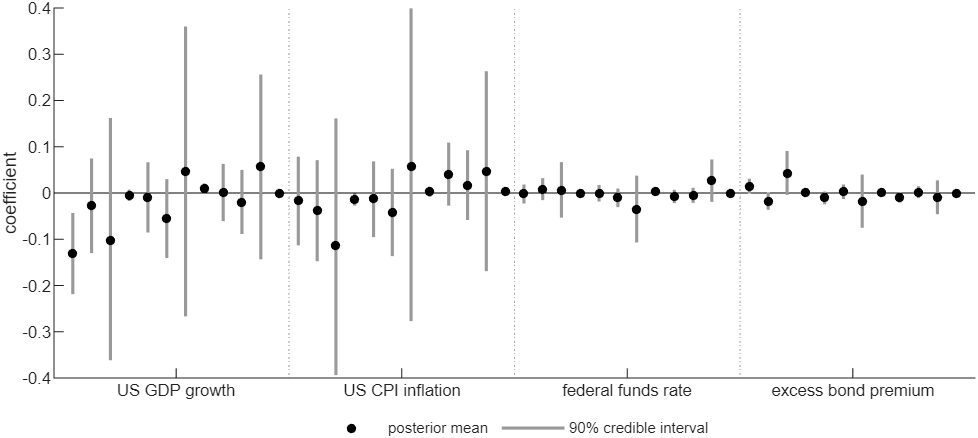
Figure 1: The coefficients of the four US equations on the Australian lags in the unrestricted VAR, with their posterior means and 90 percent credible intervals. Each section contains the twelve coefficients of one equation: the four Australian variables at lags one, two and three. Their true values are zero.
Try it
In MATLAB, from the root of a copy of bvar-toolkit, run the script that prints every number and draws every figure of the guide:
run guides/soe_var/guide.m
In this series
Next: How to Test Block Exogeneity by the Marginal Likelihood