How to Trace a Foreign Shock through a Small Open Economy
Guide 3 of 3 in the series VARs for a Small Open Economy
Based on Bayesian Macroeconometrics (Chan, 2027)
[ Full guide on GitHub ]
How to Estimate a VAR for a Small Open Economy treats Australia as the small open economy and the US as the foreign economy. Its VAR has a foreign block of US variables and a domestic block of Australian variables. Every US shock can move the Australian variables, and no Australian shock moves a US variable. In this guide we trace one US shock through the eight variables: a rise in the excess bond premium of Gilchrist and Zakrajšek (2012). They interpret this rise as a contraction in the supply of credit.
As in the estimation guide, the true model is a VAR with block exogeneity fitted to US and Australian data. We simulate a sample of 141 quarters from the true model, the same sample as in the estimation guide. The true responses to the shock are then known, and the posterior can be compared with them. We identify the shock recursively within the US block and compute its effects for every draw from the posterior of that guide.
In the true model, a shock of one standard deviation raises the premium by 0.25 percentage points. US GDP is 0.43 percent lower after a year. The Australian dollar depreciates by 1.83 percent in the quarter of the shock, and Australian GDP is 0.14 percent lower after a year. In this sample, the posterior bands contain the true responses of four of the eight variables at every horizon. The posterior median overstates the depreciation of the Australian dollar after a year, 3.54 percent against the true 1.58.
The steps
- Compute the Responses to the Shocks
- Compute the Responses for Every Draw
- Measure How Much the Shock Explains
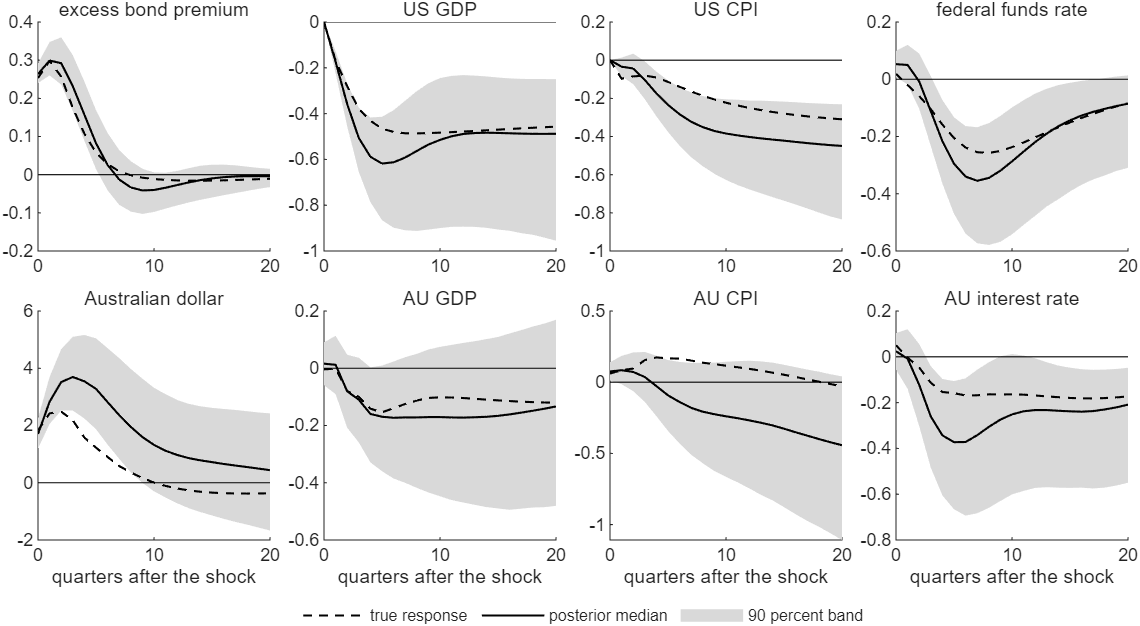
Figure 1: The responses to a shock of one standard deviation to the US excess bond premium, in the true model and in the posterior from the sample. The bands are pointwise 90 percent bands. GDP, the CPI and the Australian dollar are in percent of their levels, and a positive response of the dollar is a depreciation. The interest rates and the premium are in percentage points.
Try it
In MATLAB, from the root of a copy of bvar-toolkit, run the script that prints every number and draws every figure of the guide:
run guides/soe_foreign_shock/guide.m
In this series
Previous: How to Test Block Exogeneity by the Marginal Likelihood